Poured concrete or pavers? It is the first decision most homeowners face for a new patio, and the sales pitches on each side rarely tell the whole story. In a warm climate it hardly matters. In Wisconsin, where the ground freezes and thaws all winter, it matters a lot.
We build both, so we do not have a dog in this fight beyond building something that lasts. The honest answer is that each has real strengths, and the right pick depends on your budget, your timeline, and how long you plan to live with it.
This is a straight comparison — how pavers and concrete each handle freeze-thaw, cracking, repairs, and drainage — so you can decide with clear information instead of a sales script.
Key Takeaways
- Freeze-thaw is the real test in Wisconsin — it cracks rigid slabs and shifts poorly built bases.
- A poured slab is one rigid piece that cracks; pavers flex at their joints and ride out ground movement.
- Pavers are repaired by lifting and resetting individual units; concrete cracks are hard to hide.
- Concrete usually costs less upfront; pavers tend to win on longevity and repairability here.
The Real Enemy: Freeze-Thaw
Every patio in the Fox Cities lives with freeze-thaw. Water seeps into the ground and into the surface, freezes, expands, and thaws — dozens of times a winter. That constant expansion and contraction is what wrecks hardscape here. It is not the cold itself; it is the movement.
Both surfaces have to answer to it, and they answer differently. A poured slab tries to resist the movement as one rigid piece. Pavers accommodate it. Understanding that difference explains almost everything else about how the two perform over a Wisconsin decade. Either way, the base underneath does the heavy lifting, which is why we build every paver patio on deep, compacted gravel.
Cracking and Movement
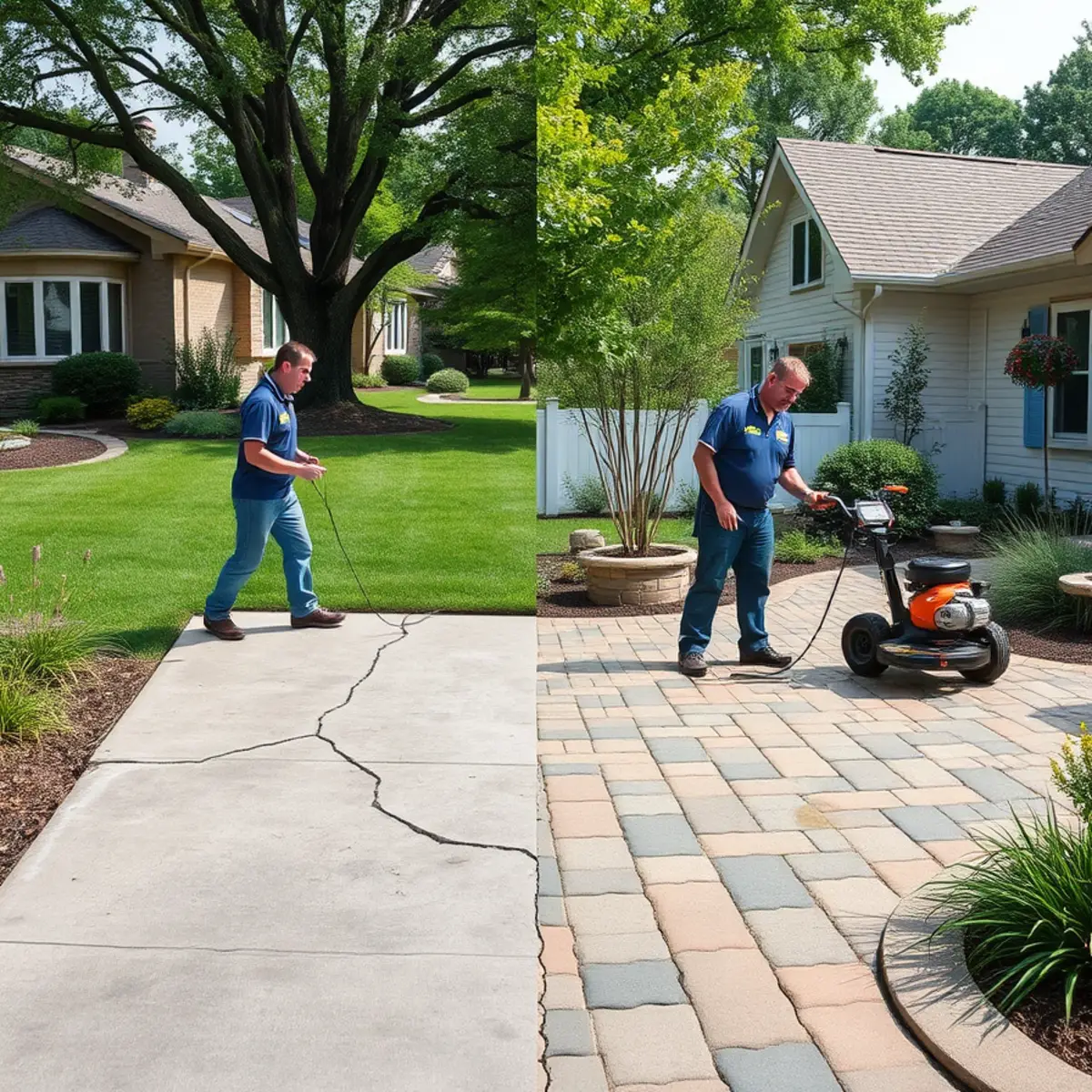
A poured concrete patio is a single rigid slab. When the ground beneath it heaves unevenly — and clay soil under freeze-thaw always does — the slab has nowhere to give. So it cracks. Control joints steer where cracks form, but they do not prevent them. A concrete patio in our climate is not a question of if it cracks, but when and how visibly.
Pavers take the opposite approach. A paver patio is many small units set on a flexible sand-and-gravel base, with joints between them filled by polymeric sand — a jointing sand that hardens yet still allows tiny movement. When the ground shifts, the joints absorb it and the surface stays intact. Instead of one big crack, the patio flexes as a field. That is the core reason pavers tend to age better here.
Repairability When Something Goes Wrong
Nothing outdoors is permanent, so how a patio is repaired matters as much as how it holds up.
If a paver settles, stains, or cracks, you lift the affected units, fix the base beneath, and reset them — often with pavers set aside from the original job so the repair disappears. A section damaged by a heavy vehicle or a tree root can be rebuilt without touching the rest.
Concrete is far less forgiving. A crack cannot really be undone; patches and fillers are visible and rarely match. Serious damage usually means breaking out and repouring a whole section, with a fresh seam where old meets new. For a surface facing decades of freeze-thaw, that repairability gap is a genuine long-term cost difference.
Drainage and Permeability
Concrete sheds water. Every drop that hits the slab runs off to the edges, which means you have to plan where it goes, or it pools against the house or the patio's low side. In our clay soils that runoff can be a real problem.
Pavers can be laid as a permeable system — with open-graded joints and base that let water pass through the surface and soak into the ground below. In a climate with heavy snowmelt, that is a meaningful advantage: less runoff, fewer puddles, and less strain on the rest of your yard's drainage. When a patio ties into a broader plan for drainage or connects to walkways and garden paths, permeable pavers give you options a solid slab cannot.
So Which Should You Choose?
Here is the honest breakdown. Poured concrete generally costs less upfront and installs quickly, which makes it attractive on a tight budget or timeline. If you go that route in Wisconsin, insist on a proper base and expect some cracking over the years.
Pavers cost more at the start but usually win over the long run here — they flex with our freeze-thaw, repair invisibly, and offer permeable options. If you plan to stay in the home and want a surface that still looks right in fifteen years, pavers are typically the better value despite the higher initial price.
There is no universally correct answer, and we will tell you straight which fits your situation. Homeowners in Appleton and Little Chute land on both, depending on budget and how long they are staying put. The worst choice is either one built on a shortcut base — that is what fails first, regardless of the surface.
Want a hand with your project?
The owner offers free, no-obligation estimates across Appleton and the Fox Cities.
Frequently Asked Questions
Over time, almost always to some degree. Freeze-thaw heaves clay soil unevenly, and a rigid slab has nowhere to flex, so it cracks. Control joints direct where cracks appear but don't prevent them. A quality base and proper thickness slow it down, but a crack-free concrete patio here is the exception.
For most homeowners staying in their home, yes. Pavers flex with ground movement instead of cracking, individual units can be lifted and reset invisibly, and permeable options help with drainage. Concrete is cheaper to install, but pavers usually win on longevity and repair cost over a Wisconsin decade.
They can. Permeable paver systems use open joints and base that let water soak through the surface into the ground rather than running off. In a climate with heavy snowmelt and clay soil, that reduces puddling and runoff. A solid concrete slab sheds all its water to the edges instead.
The base. Whether pavers or concrete, a deep, well-compacted gravel base is what resists frost heave. Most patio failures here trace back to a base that was too shallow or poorly compacted. Spend on the part you never see and the surface you walk on lasts far longer.
Related Services & Areas
Services
Service Areas

Written by the team at Down To Earth Landscaping, an owner-operated landscaping company serving Appleton and the Fox Cities for over 20 years. We design, build, and maintain outdoor spaces built for Wisconsin's climate.