Ask three homeowners what their paver patio cost and you will get three very different answers — even for patios that look about the same size. That is not a pricing trick. It reflects real differences in what went into the ground.
We build patios across Appleton and the Fox Cities, and most of the cost lives in places you never see once the job is done: the depth of the base, how the site drains, and how hard it is to get material into the backyard. This guide walks through the factors that move a quote up or down so you can read your proposal with clear eyes.
We do not publish flat prices here, because an honest number only comes from seeing your yard. What we can do is explain what to look for, and why a line-item proposal beats a one-line bid every time.
Key Takeaways
- Size matters, but the base — its depth and compaction — is where much of the real cost sits.
- Our freeze-thaw climate demands a deep, well-compacted gravel base; skimping there is what fails first.
- Drainage, grading, and backyard access can swing a quote more than the pavers themselves.
- A written, line-item proposal lets you compare bids fairly instead of guessing.
Why Two Patios the Same Size Cost Different Amounts
Square footage is the number everyone fixates on, and it does drive material and labor. But it is a starting point, not the answer. A simple rectangle on flat, dry ground with a driveway ten feet away is a very different job from a curved patio on a soggy slope you can only reach by wheelbarrow through a side gate.
The factors below stack on top of size. Understanding them is the difference between a bid that looks cheap and a patio that stays flat. A good paver patio installation prices the whole picture, not just the top layer you will walk on.
The Base Is Where the Money Goes
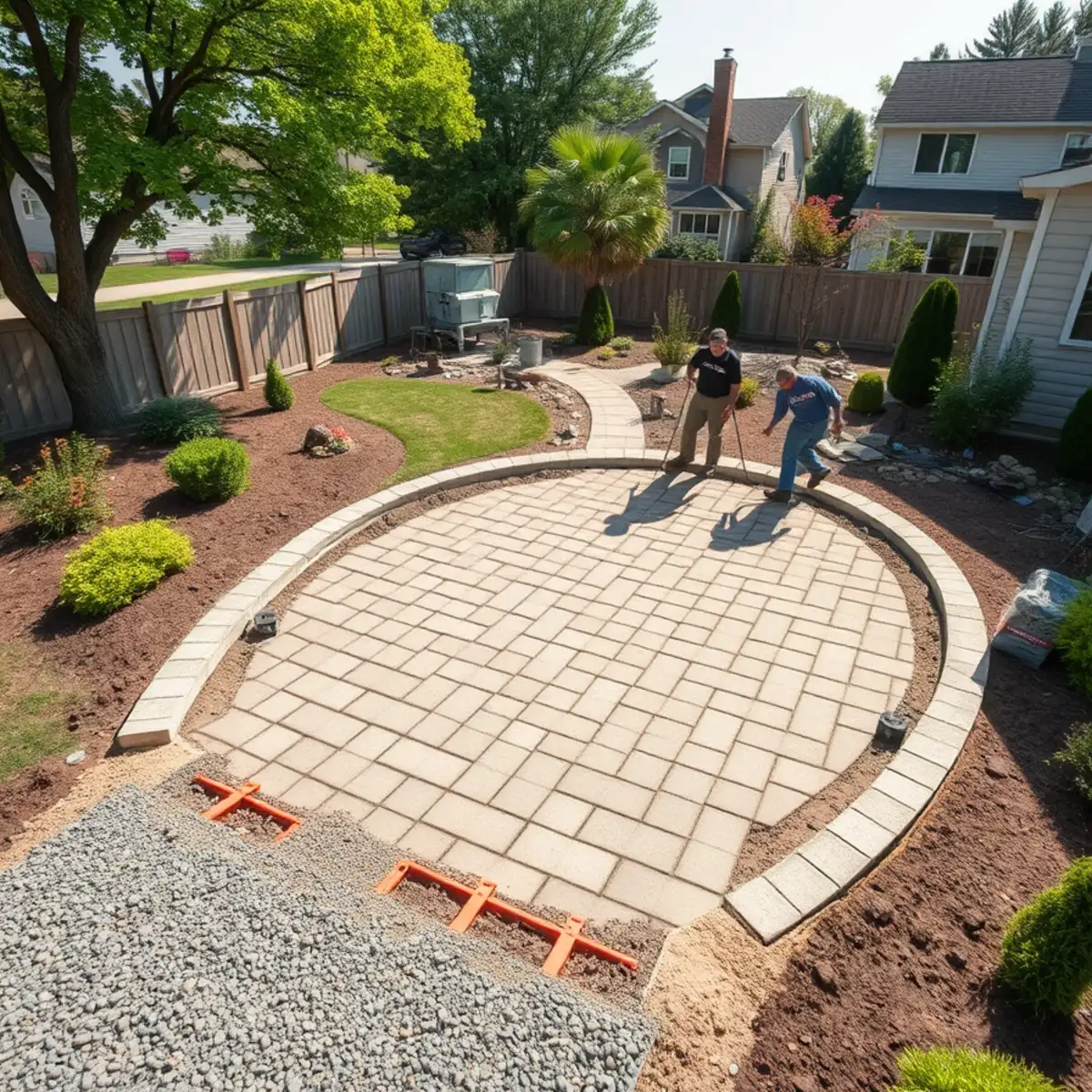
Under every paver patio is a compacted gravel base. In the Fox Cities, that base is not optional and it is not the place to cut corners, because of freeze-thaw. Freeze-thaw is the winter cycle where water in the soil freezes, expands, then thaws — over and over. It heaves whatever sits above it. A shallow or poorly compacted base lets that movement telegraph up through your pavers as humps, dips, and gaps.
A proper base means excavating well below the pavers, laying gravel in lifts, and compacting each layer. Deeper bases cost more in excavation, hauling, stone, and machine time — and that depth is exactly what keeps the patio level through a decade of Wisconsin winters. When you compare quotes, ask how deep the base goes. It is the single most telling line on the proposal.
- Excavation depth and how the spoil (dug-out soil) is hauled away
- Amount of crushed gravel and how many compaction passes
- Whether the base steps down below the frost line for anything with a footing, like a seat wall or pillar
Material, Pattern, and Edge
Paver choice is the part you get to enjoy, and it spans a wide range. Standard concrete pavers sit at one end; tumbled, textured, and premium lines sit higher. Larger-format and natural stone units generally cost more to buy and to set.
Pattern adds labor. A running bond is quick; a herringbone or a pattern with lots of curves and borders means more cuts, more waste, and more time on knees. The joints matter too — we finish with polymeric sand, a jointing sand that hardens when wetted to lock pavers together and slow weeds. It costs a bit more than plain sand and holds up far better through our winters.
Drainage, Grading, and Site Prep
Water is the quiet budget item. Our clay-heavy soils shed water slowly, and a patio that traps snowmelt against the house is a problem you will regret. Sometimes the fix is simple pitch away from the foundation. Sometimes it means tying in drainage solutions — a French drain, a dry well, or regrading — before a single paver is set.
Site prep covers everything that has to happen before the build: removing sod or an old slab, dealing with tree roots, correcting a low spot. None of it shows in the finished patio, but all of it shows in the quote. A yard that needs regrading in Appleton will price differently than a flat lot in nearby Kaukauna.
Access, Complexity, and the Proposal Itself
Access is underrated. If a skid steer can reach the work area, material moves fast. If everything has to be carried by hand through a narrow gate or over an existing deck, labor climbs. Steep yards, tight corners, and long carries all add hours.
Complexity beyond the flat surface adds up too: seat walls, steps, fire pit pads, built-in lighting sleeves, and integration with existing hardscape. Each is worthwhile, and each has a cost. This is why we put everything in a written, line-item proposal. You should be able to see what the base, the pavers, the drainage, and the extras each contribute — and adjust the scope before we start rather than after. Bundling patio work into a broader landscape design plan often saves a return trip and a second mobilization.
Want a hand with your project?
The owner offers free, no-obligation estimates across Appleton and the Fox Cities.
Frequently Asked Questions
Because the base depth, drainage needs, and access vary so much yard to yard that a phone number would be misleading. A flat, dry, easy-access lot and a sloped, wet, hard-to-reach one can differ substantially at the same square footage. A free on-site estimate gives you an honest figure.
In our freeze-thaw climate, yes. The base is what resists frost heave. A patio that saves money on base depth is the one that shifts and settles within a few winters. Spending on the base you cannot see protects the pavers you can.
Not always. Some yards only need proper pitch away from the house, which is built into good grading. Others need a French drain or regrading to handle snowmelt in our clay soils. We assess this during the estimate so there are no surprises mid-project.
A clear scope: excavation depth, base material and compaction, paver product, jointing sand, edge restraint, drainage or grading work, and any extras like seat walls or lighting. Line items let you compare bids fairly and understand what you are paying for.
Related Services & Areas

Written by the team at Down To Earth Landscaping, an owner-operated landscaping company serving Appleton and the Fox Cities for over 20 years. We design, build, and maintain outdoor spaces built for Wisconsin's climate.